Research Update 3: Centre des archives diplomatiques de Nantes

Part I of my research year took me to Nantes, France (see my previous post for more general, non-research related thoughts on my time there). I worked for six weeks in the Centre des archives diplomatiques in Nantes (CADN), a branch of France’s national archives that deals with documents produced by the diplomatic office and holds materials for the French mandate in Syria and Lebanon between World War I and World War II.

Below is a rough daily schedule of my time in Nantes to give you an idea of what my six weeks working in the archive looked like:

Some time between 6:00 and 7:00 AM – Wake up and contemplate the day: Should I go for a jog first? What’s the temperature like? Do I want to have to shower after? (The usual conclusion) Naw, I can get some stuff done and enjoy a slow morning if I don’t.

6:00 – 9:00 AM – Eat breakfast, enjoy a leisurely coffee/tea, check Facebook (my main connection to home) and news, download pictures from previous day and update Excel spreadsheet if not done the night before.

9:00 – 9:30 AM – Head out the door to the archive. I lived a little ways away, so I had a 10-minute or so walk to the tram, 15-minute tram ride, and 15-minute walk to the archive. It was generally a nice time to catch some brisk fall air, a walk, and to organize my thoughts for the day ahead.

9:45 – 10:15 AM – Arrive at the archive and have awkward conversation with security using my limited French. Be nervous about the metal detector for no reason.

10:15 AM – Choose my seat and request the first box of materials, simultaneously hoping for a hidden treasure and for there to be nothing helpful; the former obviously necessary for furthering my research, the latter to reduce time spent taking and processing pictures.

10:15 AM – 1:00 PM – Work through boxes requested the previous day. In the first couple weeks, I’d go through about 3 boxes in the morning before lunch and 4 after. As time went on, the boxes I requested had fewer relevant materials (being no longer from the Public Instruction archive) and I sometimes would finish with all 7 (the daily limit) by 1:00.

1:00 – 1:30 PM – Request boxes for the next day and eat lunch (this I brought with me from home; it always included a baguette. So good). This was also an opportunity to sometimes chat with other researchers, which was always pleasant.

1:30 – some time in the afternoon – How much time I spent at the archive for the rest of the day was largely dependent on whether or not I found relevant materials. I noticed that  people had all kinds of techniques for working through the documents. I tried two main techniques: 1) Going quite methodically through materials, taking notes on relevant documents and taking pictures, filling out my spreadsheet as I went 2) Going methodically, but just taking pictures of relevant documents while at the archive and making my notes when I got home. The second technique seemed to work better for me, as it required less time in the archive, which helped me avoid the dreaded “archive fever” (related to cabin fever and referring to feelings of restlessness and boredom resulting from extended presence in an archive) and allowed me to process my work in the comfort of my own place with food and a tea, coffee, or glass of wine to aid me.

Afternoon – evening – This was generally my processing time (though this sometimes was moved to the morning, depending on how tired I was from the day’s work–translating and picture-taking are surprisingly mentally exhausting–or if there was a particularly good French crime drama or guardian angel show on). Processing entailed downloading the day’s pictures to my hard drive, backing them up to my external, and then uploading them to Google Photos. I’d also update my Excel spreadsheet with the relevant data (what that looks like to be shared later).

Obviously, very exciting stuff. Stay tuned for more research updates on data organization and management, daily schedules, my time doing research in Beirut, and my trip to the League of Nations archive in Geneva. For now, I’d love to hear in the comments about what others’ archival work days look like, how you avoid archive fever, etc.
Research Update 2: Syrian Ladies’ Aid Society, in Conclusion

I finished the paper for this project (see post title) just over two years ago. I never got a chance to update my blog to document the research and writing process as planned, but I thought I might hit the high points and conclude that project out here. I hope you’ll find some helpful insights and maybe more info about the project that intrigues you.

As I alluded to in my first and only post on the subject, the research itself was a bit of a weather adventure and I didn’t get to spend as much time in the archive at the Arab American National Museum as I would have liked (in fact, I spent most of my trip watching Netflix and the accumulation of snow). I was able to get enough to complete the project, but it is something I hope to return to in the future. Some highlights from the project (research, writing, and completion):

Title: “To Help All Syrian and Lebanese Wherever”: The Syrian Ladies’ Aid Society and Cultural Maintenance in the Diaspora

Main argument: Through their charitable and fundraising activities, the women of the Syrian Ladies’ Aid Society played a key role in the creation of a Syrian-American identity in the diaspora as they moved women’s role in cultural maintenance from the home to the political and transnational public sphere.

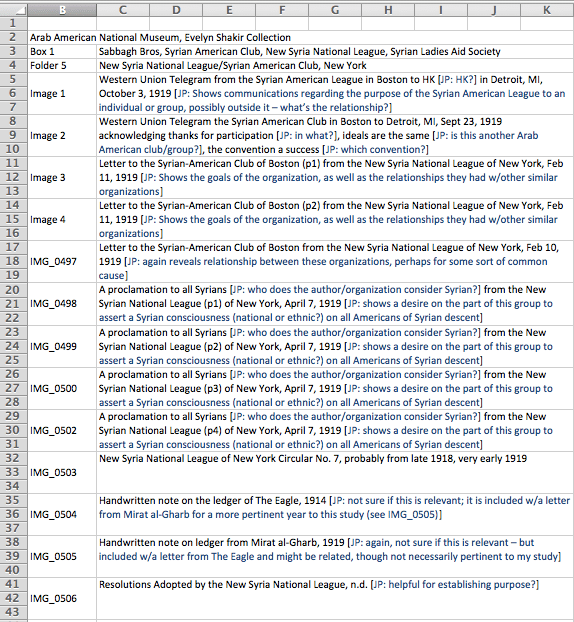
Research process: Pictures (approximately 300; researchers who spend weeks and months in the archive have thousands of pictures to sort through). Because my time in the archive was limited to begin with and ended up being even more limited as a result of weather, the two half days of research I was able to do was a flurry of picture-taking and quick note-making that I got to process when I got home. Here’s an image of my image database, using Excel (this was the first half day, when I thought I would have two and a half more days of research, so my notes are more complete):

Screen Shot 2016-07-04 at 6.22.27 PM

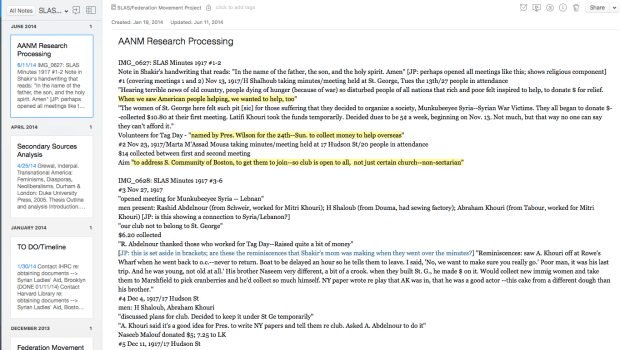
I duplicated this list to some extent in Evernote in order to draw out some of the main themes (see image below). It worked well for me, but I think it was a lot of duplicating work and I’m thinking of better ways to organize myself for my dissertation, where my pictures will number in the several thousand, I’m sure. One of my colleagues uses Google Drive and tags his pictures so that he can easily search for specific documents. I think you can also describe and annotate the image. I’ll check it out and write about it as my research progresses.

Screen Shot 2016-07-04 at 6.26.46 PM

Writing: A LOT of drafts. Going through my folder, I have about 15 drafts saved, from initial thematic write-ups to several versions of the full document. Looking through them, I can see how my paper evolved in significant ways over the several weeks and many drafts. I also remember the many breakthroughs and insights I had while working on these drafts that, in many ways, reshaped my paper’s entire argument and, ultimately, made it a better paper. I seem to recall that, in order to complete this project, I devoted a particular amount of time per day to writing for it. I’m guessing about an hour. This is a process I hope to continue as I work on my dissertation and other future projects. I’ll keep you updated on how that works out, too.

Completion: Though this project had a formal completion date, I find that none of my projects are ever really done, and I look forward to returning to this one at some point, maybe revising it to write an article. If that happens, I’ll keep you in the loop about that, too!

What is your writing process like? What projects (academic, non-academic, personal) are you working on right now?


5 Things: A Graduate Student’s Summer “Break” To-Dos

I’ve reached the end of my two-week schoolwork break. I’ve gotten a chance to catch up with friends and family, and spent five days in San Francisco. I’ve almost finished my (incomprehensible mumbling of an embarrassingly high number) re-read of the Harry Potter series. It’s been lovely.

Though I’m not doing anything this summer in the way of teaching or grading, I’ve got plenty on my plate, a lot of it put on the “to do later” list during the school year (/the last several school years…). So, without further ado, five things you can do (and I’ll be doing) as a graduate student during summer “break”:

  1. Organize your note-taking and documents storage systems. In my first year of graduate school, the history and theory class I was taking spent two full sessions (that’s six hours) going over the various note-taking, document storage, and productivity tools that make all the information you’re processing easier to access throughout grad school and in professional life. Possibly the most helpful six hours of class time ever. I use Evernote for note-taking and -keeping and Google Drive for document storage. Use whatever platform(s) works best for you. My goal this summer is to settle on a citation manager and figure out how to use it.
  2. Brush up on that language(s) you need for your research. Reviewing grammar and vocab is great, but it’s the summer, so mix it up and keep it fun! In addition to academic texts and primary documents, read news, listen to music, and watch TV shows and films.
  3. Prepare for the coming year. Check out your institution’s graduate student handbook and see where you’re at in meeting the requirements. What do you need to do in the next year to keep you on track, whether you’re still in coursework, preparing for exams, setting out on research trips, or completing dissertation grants? What can you do this summer to make the school year (or at least part of it) a little more bearable?
  4. Update (or create) your five-year plan. Closely related to #3 above, thinking long term helps you stay on track (coursework, exams, grants and fellowships, publication submissions, etc) and keeps all those pesky deadlines (holy grants, Batman) from sneaking up on you. As you progress through your program, it’ll also help you think about life post-grad school and you can begin shaping that sooner rather than later.
  5. Relax. Brain breaks and academic disconnects are necessary for recharging, remembering why you’re doing this, starting the school year refreshed, and getting ready to tackle the next challenge. My plan is to do about four to six hours (let’s be real, four or less is what will most likely actually happen) of concentrated work per day, Monday through Friday, with weekends and a few vacations completely off.

Any other suggestions?

Resolutions

‘Tis the season for making resolutions. Here’s what I hope you’ll see on the blog for the following year:

A continuation of the Roll Call series, updated weekly on Sundays. I’d love to hear any thoughts or suggestions on this front – I’ve been using it as an easy way to update my blog on a fairly regular basis that doesn’t require too much effort on my part. What might be more interesting to you as the reader? What, if anything, would you like to see developed with/in addition to this series?

An overview of the week’s readings, updated weekly on Fridays. I had intended to do this last quarter, but time got away from me.

Development of the annotated bibliography. I saw this on another PhD student’s blog and thought it was a good idea. I’m still working out the kinks – trying to figure out what I want to include, how I want to include it, and how I want it to be organized – but aim to get that going by the end of January.

An inclusion of research notes and updates. There will actually be more to come soon on this as I take my first research trip as a PhD student! Aside from that, I hope to provide, perhaps monthly, updates on any research I’m undertaking. For the remainder of this academic year, I’ll be focusing on the research paper I’ll be producing by the end of June. Since I’ve not talked about that at all yet, be on the lookout for more on that front generally, coming soon.

More links to articles, conversation-starting thoughts and questions, and thought-pieces on academia generally. Most of what I’ve done so far with this has been light and usually humorous. While those types of articles/links will still be included, I plan to include some more hard-hitting content.

What resolutions are you making? Is there anything that you’d like to see more of on my blog or anything in addition to what I’ve listed here?

Happy New Year!

Preparations

You could say I’m a planner. Planning is one of my favorite things to do. When I was in high school and college my favorite day of the school year was the first day of each new semester when I would get the class syllabus. When I’d get back to my dorm, apartment, whatever, I would meticulously (color coded and everything) add assignment due dates, test dates, and class activities to my planner (still paper then). Pure joy.

While I’m still looking forward to that with the start of my PhD program, I know things will be a little different, a lot more fluid, and much more up to me to keep myself on task. So, over the past month or so, I’ve been trying to get myself ready and organized for the years (yes, years) ahead.

I’ve been looking up information on grants and fellowships for which I could apply, from language study to research, to post-doctoral opportunities. I’ve joined several H-Net groups and actively peruse the daily and weekly emails for relevant information. I’ve started looking into citation managers (I didn’t use one when I did my master’s but was told that they are a great help). For now, I’ve organized for myself a single Word document with all of the relevant information I’m collecting: fellowships and grants, conference opportunities, journals and other publications, books to look into that seem relevant, as well as some new research ideas I’ve come across just from what I’ve looked at so far.

What I want to know is: are there better options out there (than my current Word document solution) for organizing the to-dos for grad life? Is there a single, magical, constantly updated website or blog out there with all of the information I could ever want as a graduate student and someday professional? Or something like it? What have you used to organize your life, research, and fellowship and grant information?

Oh, and I still use a planner. A real paper planner.