Research Update 3: Centre des archives diplomatiques de Nantes

Part I of my research year took me to Nantes, France (see my previous post for more general, non-research related thoughts on my time there). I worked for six weeks in the Centre des archives diplomatiques in Nantes (CADN), a branch of France’s national archives that deals with documents produced by the diplomatic office and holds materials for the French mandate in Syria and Lebanon between World War I and World War II.

Below is a rough daily schedule of my time in Nantes to give you an idea of what my six weeks working in the archive looked like:

Some time between 6:00 and 7:00 AM – Wake up and contemplate the day: Should I go for a jog first? What’s the temperature like? Do I want to have to shower after? (The usual conclusion) Naw, I can get some stuff done and enjoy a slow morning if I don’t.

6:00 – 9:00 AM – Eat breakfast, enjoy a leisurely coffee/tea, check Facebook (my main connection to home) and news, download pictures from previous day and update Excel spreadsheet if not done the night before.

9:00 – 9:30 AM – Head out the door to the archive. I lived a little ways away, so I had a 10-minute or so walk to the tram, 15-minute tram ride, and 15-minute walk to the archive. It was generally a nice time to catch some brisk fall air, a walk, and to organize my thoughts for the day ahead.

9:45 – 10:15 AM – Arrive at the archive and have awkward conversation with security using my limited French. Be nervous about the metal detector for no reason.

10:15 AM – Choose my seat and request the first box of materials, simultaneously hoping for a hidden treasure and for there to be nothing helpful; the former obviously necessary for furthering my research, the latter to reduce time spent taking and processing pictures.

10:15 AM – 1:00 PM – Work through boxes requested the previous day. In the first couple weeks, I’d go through about 3 boxes in the morning before lunch and 4 after. As time went on, the boxes I requested had fewer relevant materials (being no longer from the Public Instruction archive) and I sometimes would finish with all 7 (the daily limit) by 1:00.

1:00 – 1:30 PM – Request boxes for the next day and eat lunch (this I brought with me from home; it always included a baguette. So good). This was also an opportunity to sometimes chat with other researchers, which was always pleasant.

1:30 – some time in the afternoon – How much time I spent at the archive for the rest of the day was largely dependent on whether or not I found relevant materials. I noticed that  people had all kinds of techniques for working through the documents. I tried two main techniques: 1) Going quite methodically through materials, taking notes on relevant documents and taking pictures, filling out my spreadsheet as I went 2) Going methodically, but just taking pictures of relevant documents while at the archive and making my notes when I got home. The second technique seemed to work better for me, as it required less time in the archive, which helped me avoid the dreaded “archive fever” (related to cabin fever and referring to feelings of restlessness and boredom resulting from extended presence in an archive) and allowed me to process my work in the comfort of my own place with food and a tea, coffee, or glass of wine to aid me.

Afternoon – evening – This was generally my processing time (though this sometimes was moved to the morning, depending on how tired I was from the day’s work–translating and picture-taking are surprisingly mentally exhausting–or if there was a particularly good French crime drama or guardian angel show on). Processing entailed downloading the day’s pictures to my hard drive, backing them up to my external, and then uploading them to Google Photos. I’d also update my Excel spreadsheet with the relevant data (what that looks like to be shared later).

Obviously, very exciting stuff. Stay tuned for more research updates on data organization and management, daily schedules, my time doing research in Beirut, and my trip to the League of Nations archive in Geneva. For now, I’d love to hear in the comments about what others’ archival work days look like, how you avoid archive fever, etc.

Slàinte, Cheers, Santé

Before this year, I had been to four countries outside the US: Canada, Mexico, Norway, and Sweden. I’m in the “research year” of my PhD program, and to kick it off my husband and I decided to take a wee vacation that took us to Scotland, London, and Paris. The main motivation of our trip was whisky. London and Paris were a bonus. So, without further ado, some picture highlights from our trip:

Day 1: London. After the 10-hour flight from LAX, we had about 8 hours to kill before our overnight train to Inverness. We got off the tube at Westminster, walked around a bit, and went to a fancy (read: overpriced but delicious) bar for a cocktail.

Day 2: Inverness. We spent one full day in Inverness after spending all night on the train. After spending 10 hours in the air. And 8 hours walking around London. Needless to say, when we visited a really cool bookshop, I may or may not have fallen asleep standing up every time I stopped to look at a shelf.

Day 3: Inverness to Isle of Skye. This was our first experience of the landscape of the Highlands and the trip took us along Loch Ness and to a little tea shop somewhere between Inverness and the Isle of Skye. Breathtaking is simultaneously the best and most inadequate word to describe it.

Day 4: Isle of Skye / Talisker. We stayed at a very cute B&B on Loch Harport. Our first day was rainy, though a bit less so than the deluge that welcomed us to Skye the afternoon before. We visited Talisker Beach and the distillery, went to the Oyster Shed, and generally enjoyed a lot of good whisky.

Day 5: Isle of Skye / Coire Lagan. This day took us into The Cuillin, the mountain range that commands the landscape from many places on the island on a clear day. I’m of the opinion that Tolkien’s Middle Earth is in fact the Isle of Skye and The Cuillin was the inspiration for Mordor.

Day 6: Isle of Skye / Neist Point, Coral Beach, and, Portree. Another drizzly day that took us all over the northern half of the island that, as every other day, brought with it spectacular views, cafes with good tea, warm soup, and internet, and wonderful memories.

Day 7: Isle of Skye to Speyside. This was a very long driving day that took us from Skye across most of northern Scotland. We began the day with a bit more sightseeing on Skye (stopping at a landslip known collectively as the Quiraing and at a spot where you’re supposed to be able to see dinosaur bones or footprints or something – didn’t see anything) but spent the rest of the day driving along lochs, through great forests, on windy mountain roads, and among rolling golden fields of wheat. Idyllic (if sometimes a bit slow when stuck behind a truck or a distracted tourist on a one-lane road).

Day 8: Speyside / Cardhu, Aberlour. A day for random adventures, we stopped by Aberlour (no tour though), had a tour and tasting at Cardhu (the only distillery founded by a woman, but today it mostly supplies Johnny Walker), and visited a still-functioning wool mill that is now also a museum.

Day 9: Speyside / Strathisla, the coast. This was a lovely day that started off with a tour of Strathisla, the oldest distillery in Scotland and my favorite (Strathisla supplies the spirits for Chivas, but they also have their own, which is delicious). After our 10 AM tour and tasting (why not?), we got some lunch and headed to the coast. At the end of the day we went back to Aberlour to see if they had any tours available for the next day (they didn’t) and were offered a wee dram of a sherry-cask-aged 16-year scotch (which we whole-heartedly accepted) before going on a walk that took us along the distillery’s many buildings, by a pretty waterfall, and back to town.

Day 10: Speyside to Inverness. Our last day in Scotland and my last day of driving on the wrong side of the car and the road. We stopped in Findhorn for a walk along the shore, lunch, and an ice cream, and then headed back to Inverness to catch our overnight train back to London.

Day 11: London. Slept much better on the train this time around, amazingly, and after a bit of difficulty getting into our Airbnb (though not too much), we set out for an afternoon in London. We didn’t take any tours, but we did walk along the Thames, past the Old Globe, across several bridges (including Tower Bridge and Millenium Bridge – for those Harry Potter fans out there, the latter is the one the Death Eaters destroy at the beginning of the sixth movie) and went to a very hip (again, read: overpriced but delicious) bar recommended by the bartender at the first fancy bar we went to in London all the way back at the beginning of our trip.

Day 12: London 2. We spent the morning at the Tower of London. It was a chilly, grey day and it made me appreciate insulation and central heating. The rest of the day was spent walking around and ended at Buckingham Palace.

Day 13: London to Paris. The train from London to Paris was quite nice. I don’t have any pictures from this day as it was long and a bit trying as I got to use my wholly inadequate French for the first time.

Day 14: Paris. This was a day for cathedral visits, beginning at Sainte-Chapelle and ending at Notre Dame. The main thing I can say about Sainte-Chapelle (which, apparently has the nickname “the jewelry box”) is that, when I entered the second-floor chapel at the top of the winding staircase that ran up one of the turrets, I was greeted by the early-afternoon sun dazzling through brightly-colored stained glass windows that ran across the whole length of the wall and made up about two-thirds of its height. Few things in life have instantly moved me to tears, but this did. None of my pictures could do it justice.

Day 15: Paris 2. The morning of our second day in Paris was spent at the Musee d’Orsay. The rest of the day was spent hitting the most touristically famous sites – the Louvre (from the outside), the Champs Elysees and Arc de Triomph, and the Eiffel Tower. It was a lot of walking and was really quite lovely.

* * *

Have you been to any of these places? If so, what were your favorite spots/stops?

Hello from Nantes!

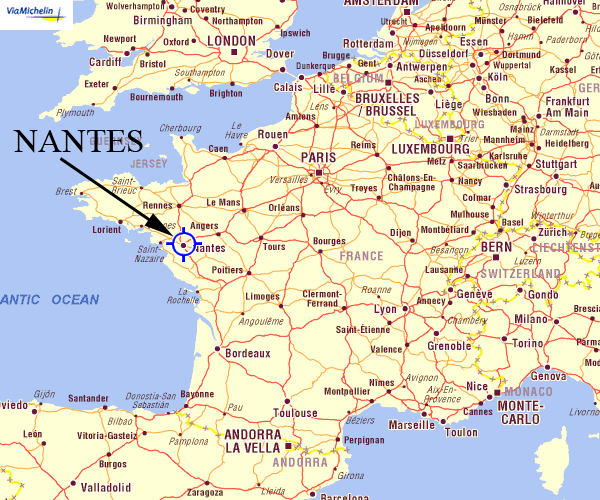
The first leg of my research year has just about come to a close. It’s been a simultaneously long and short six weeks in Nantes, France (see helpful map below), and I’m looking forward to see what Beirut has in store for me. I’ll get into the ins and outs of my research time, but I thought I’d devote this post to talking about some of the things I’ve been doing here that aren’t related to research.

As most anyone who knows me could tell you, I’m a fairly committed introvert and can very happily spend an entire weekend at home, enjoying a good book, podcast, show, or movie (or, all of the above). This means that I’ve read – or have started to read – a fair few books (all of the Daughter of Smoke and Bone series by Laini Taylor, Amy Poehler’s Yes Please, Diana Gabaldon’s Outlander series, and Yaa Gyasi’s Homegoing) and almost completed the crossword puzzle book I got to entertain me on the long flight from Los Angeles to London. I’ve also enjoyed Outlander (the TV show; it’s why I started reading the books), Brooklyn 99 (hilarious!), and Poldark (not too bad, with beautiful cinematography, though the writing falls short at times), all of which aren’t available on US Netflix – sorry – but are worth a watch if you can get them some other way, as well as some French news programs and crime dramas.

Located on the Loire river on France’s Atlantic coast, Nantes is a large city of almost a million people in its greater metropolitan area, and is the largest city in the region.

63c88d857da5df3ef420d291df1ee52f
Accessed from: reflectim.com

It’s also a very old city, having existed as a site of some importance since ancient times. In fact, there’s a place in the city, near the restored Chateau de ducs de Bretagne, that has been marked off as a historical site containing the remains of the oldest and newest walls in the city – from a wall built by the Romans in the third century, to those constructed in the medieval and early modern periods, all the way to the wall that surrounds the restored castle, built in the twentieth century. Near the castle is a cathedral, built in a style similar to that of Notre Dame in Paris, from what I can tell (The top two pictures below are of and from the castle; the bottom two are of the cathedral).

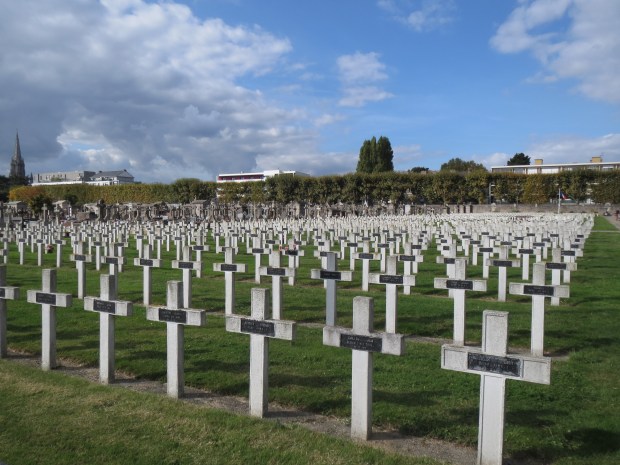
It’s history has also been shaped by the major events of the twentieth century, including both World Wars. There’s a large cemetery near the city center that includes grave sites for the French, French colonial (mostly Tunisia and Algeria, from what I could see), English, Belgian, and German soldiers who died in France during WWI.

img_2034

Aside from its history, Nantes has a pretty rich cultural life, with countless museums (many of which are free) and cultural events (also often free). I’ve made a habit of going to a permanent market that’s been in Nantes since the 1930s, Marche de Talensac; it’s open almost every morning of the week and hosts indoor, covered, and open-air stalls selling produce, meat, seafood, cheese, bread, art, bags, clothes, and a number of other things. I also enjoy regular to trips to one of the four boulangerie’s (bakery) near my apartment.

Since I’ve been here since late September, I’ve gotten to enjoy the changing seasons (which, unlike in southern California, isn’t only marked by the arrival of the pumpkin spice latte to your local Starbucks). When I first arrived, I would have my windows open wide and a tree across from my apartment was thick with green leaves. Now, I open the windows only a crack, just for fresh air, and find myself running the portable radiator for a bit in the mornings, just to get the chill out, and that same tree is now only sparsely filled with brilliantly-hued red-orange and yellow leaves. Fall has, I think, officially arrived.

Stay tuned for more on research and what I’ve been finding in the archive here!

5 Things: Podcasts

I recently got an iPad (I know, welcome to the 21st century, right?) and have become an avid listener of a variety of podcasts. While I probably enjoy listening to at least 10 different podcasts, I’ve chosen five that I can’t get enough of right now:

Stuff Mom Never Told You. This has a distinctly feminist bent, but (so?) shouldn’t preclude anyone from listening. In addition to a variety of other topics looked at from a feminist and gender perspective, earlier this summer they did a series on romantic comedies. It was great and has added several films to my must-watch list.

Stuff You Missed in History Class. These are fun and cover a variety of historical topics that, as the name suggests, you probably didn’t learn in your general education history classes. (Several weeks ago, the hosts posted to the podcast’s blog about concerns that they include “too many women” on the program. If you want to read their excellent response to that claim, click here.)

Pop Culture Happy Hour. This podcast makes me aware of how painfully unaware I am of pop culture. But they did do an episode on “Bob’s Burgers” last month that was something I know about before listening.

Ottoman History Podcast. This obviously aligns more to my particular professional and academic interests, but, like “Stuff You Missed in History Class,” the hosts and guests provide you with a look at the past that you probably never got. They also do a good job at showing how history isn’t just memorizing a bunch of names and dates.

Sit’N Listen. This comes from Harvard University’s graduate student organization, Science in the News (SITN), and has so far discussed a number of topics, ranging from GMOs to the construction of sex and gender in science (spoiler from the latter: science isn’t as objective as we like to think it is!).

Bonus for those who like politics: Off Message and The Axe Files are two I’ve been listening to lately.

Since I’m a podcast neophyte, I’d be happy to hear your recommendations in the comments!

Research Update 2: Syrian Ladies’ Aid Society, in Conclusion

I finished the paper for this project (see post title) just over two years ago. I never got a chance to update my blog to document the research and writing process as planned, but I thought I might hit the high points and conclude that project out here. I hope you’ll find some helpful insights and maybe more info about the project that intrigues you.

As I alluded to in my first and only post on the subject, the research itself was a bit of a weather adventure and I didn’t get to spend as much time in the archive at the Arab American National Museum as I would have liked (in fact, I spent most of my trip watching Netflix and the accumulation of snow). I was able to get enough to complete the project, but it is something I hope to return to in the future. Some highlights from the project (research, writing, and completion):

Title: “To Help All Syrian and Lebanese Wherever”: The Syrian Ladies’ Aid Society and Cultural Maintenance in the Diaspora

Main argument: Through their charitable and fundraising activities, the women of the Syrian Ladies’ Aid Society played a key role in the creation of a Syrian-American identity in the diaspora as they moved women’s role in cultural maintenance from the home to the political and transnational public sphere.

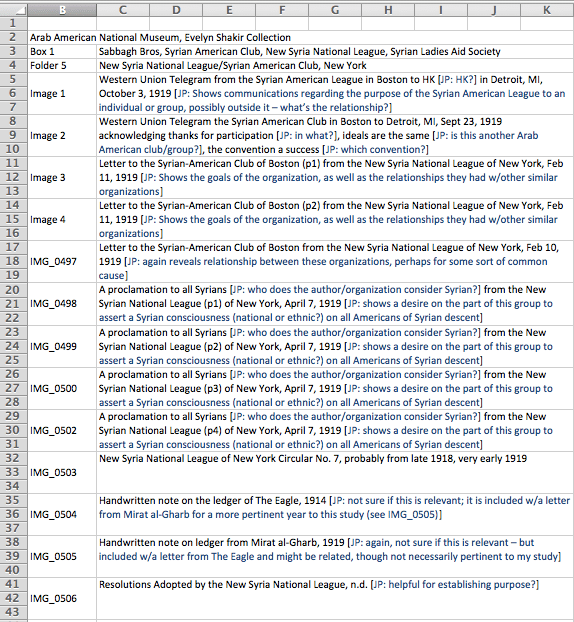
Research process: Pictures (approximately 300; researchers who spend weeks and months in the archive have thousands of pictures to sort through). Because my time in the archive was limited to begin with and ended up being even more limited as a result of weather, the two half days of research I was able to do was a flurry of picture-taking and quick note-making that I got to process when I got home. Here’s an image of my image database, using Excel (this was the first half day, when I thought I would have two and a half more days of research, so my notes are more complete):

Screen Shot 2016-07-04 at 6.22.27 PM

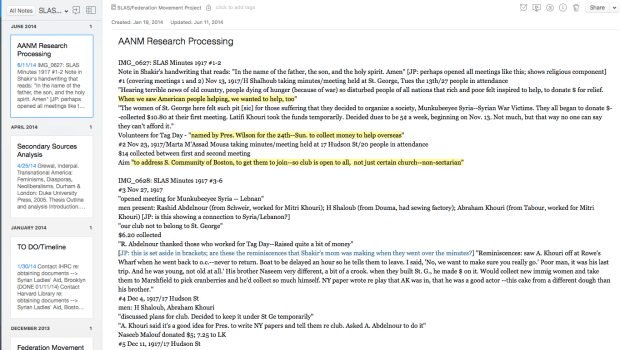
I duplicated this list to some extent in Evernote in order to draw out some of the main themes (see image below). It worked well for me, but I think it was a lot of duplicating work and I’m thinking of better ways to organize myself for my dissertation, where my pictures will number in the several thousand, I’m sure. One of my colleagues uses Google Drive and tags his pictures so that he can easily search for specific documents. I think you can also describe and annotate the image. I’ll check it out and write about it as my research progresses.

Screen Shot 2016-07-04 at 6.26.46 PM

Writing: A LOT of drafts. Going through my folder, I have about 15 drafts saved, from initial thematic write-ups to several versions of the full document. Looking through them, I can see how my paper evolved in significant ways over the several weeks and many drafts. I also remember the many breakthroughs and insights I had while working on these drafts that, in many ways, reshaped my paper’s entire argument and, ultimately, made it a better paper. I seem to recall that, in order to complete this project, I devoted a particular amount of time per day to writing for it. I’m guessing about an hour. This is a process I hope to continue as I work on my dissertation and other future projects. I’ll keep you updated on how that works out, too.

Completion: Though this project had a formal completion date, I find that none of my projects are ever really done, and I look forward to returning to this one at some point, maybe revising it to write an article. If that happens, I’ll keep you in the loop about that, too!

What is your writing process like? What projects (academic, non-academic, personal) are you working on right now?